ARTICLE ANALYSIS
My first thoughts when reading Arvanitakis’ 2017 article regarding the opaque algorithms that Facebook and Google use, was that it was opinionated to its own detriment. References to pop culture, such as House of Cards, and hyperbole affected the credibility of his otherwise valid points and credibility as a professor and university Chancellor (Western Sydney University, 2020) . A key point that is missing from his piece is to at least broadly define the parameters of his discussion. Kassan in 2018 convincingly points out the way in which the term “algorithm” in and of itself has veered away from having a precise definition and has instead become a “ubiquitous” cultural phenomenon which makes little sense to the lay person in the real world.
I believe that individuals are aware that their data is being collected and used by companies, however, may not fully be aware of the potential consequences of big data and metadata retention and distribution. Coming from an international relations and law undergraduate background I would be particularly concerned about how data collected online can impact upon the civil liberties of citizens in any given country; particularly in light of Snowden’s revelations regarding telephonic metadata collection under the United States Patriot Act in 2013. Many politicians and liberal scholars suggest that building in checks and balance processes would go towards mitigating the unintended use of data by nation state governments, for the civic good (Hu, 2018; Huddy, Khatid and Capelos, 2002; Stoycheff et. al., 2017) These regulatory and potentially legislative suggestions to combat the unethical or illegal use of personal data arguably is just as open to “interpretive liberties” though (Margulies, 2014, p. 6).
In thinking about what I was going to write for this weeks blog, I at first only briefly considered the question of whether university was the right medium through which to education people on data ethics. Writing this post today, however, and thinking about how inaccessible technological and civil rights-based concepts are to so many has me decisively opposed to universities being the sole educator on this type of information. Universities do remain an extremely privileged institution in society and navigating databases to try and inform myself on the questions posed by this weeks assignment was extremely difficult. Not only did I find myself encountering the age old academic dilemma of having to amend my searches, as per Boolean tactics touched upon in the lecture, to find relevant information- but a lot of these articles were very technically written and presuppose prior academic knowledge. Clayton in 2015 identified that publicly accessible journalism through collaboration between journalists and academics, such as The Conversation, work towards breaking down the “opaque” academic concepts into accessible information. The Conversation has a separate tag for “metadata” in it’s indexing system as per the following link: https://theconversation.com/au/topics/metadata-6464. Screenshot of this “tagged” page below:
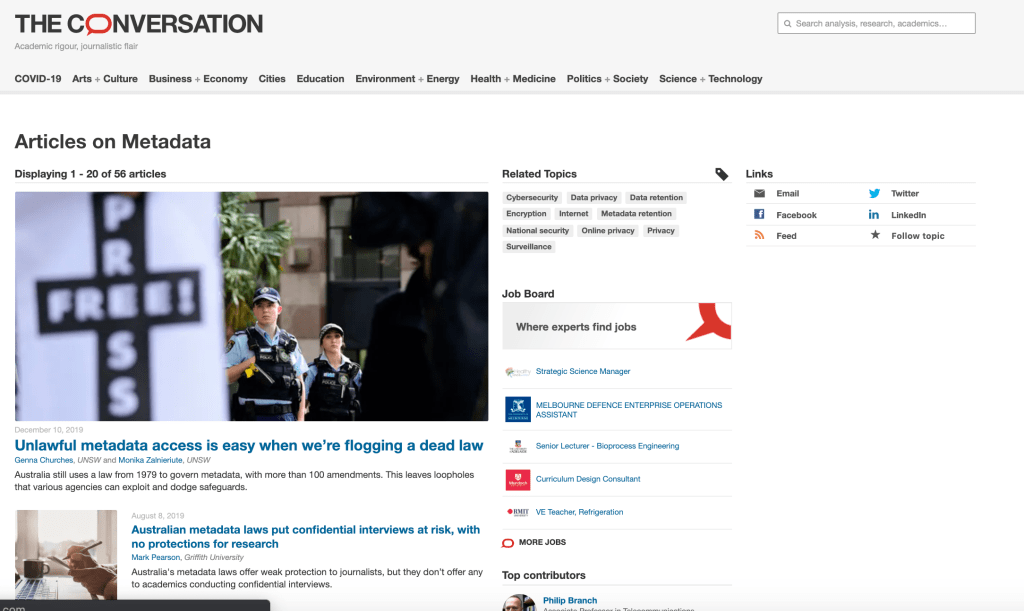
On The Conversation articles tend to only be a few pages long, are written in accessible language, and contain hyperlinks to various other sources making those sources easy to access for the every day Australian. Left political movements, and non biased journalism resources, have borne and will continue to bear the responsibility of civil liberty promotion to the layperson… though perhaps opinion pieces, such as the Arvanitakis’ article in focus are not necessarily authoritative enough to educate and persuade the reader (I suggest at the end of what is essentially, an opinion piece blog post!)
References
Arvanitakis, J (2017). If Google and Facebook rely on opaque algorithms, what does that mean for democracy? ABC News. Retrieved from: https://www.abc.net.au/news/2017-08-10/ai-democracy-google-facebook/8782970?pfmredir=sm.
Clayton, V. (2015) The Needless Complexity of Academic Writing. The Atlantic. Retrieved from: https://www.theatlantic.com/education/archive/2015/10/complex-academic-writing/412255/.
Hu, M. (2018). Bulk biometric metadata collection. North Carolina Law Review, 96(5), 1425-1474.
Huddy, L., Khatib, N., Capelos, T. (2002) Trends: Reactions to the Terrorist Attacks of September 11, 2001, Public Opinion Quarterly 66(3). https://doi.org/10.1086/341395.
Kassan, P. (2018). I’ve Got Algorithm. Who Could Ask for Anything More? Skeptical Inquirer, 42(5).
Manuel, D. (2019) Think your metadata is only visible to national security agencies? Think again. The Conversation. Retrieved from: https://theconversation.com/think-your-metadata-is-only-visible-to-national-security-agencies-think-again-121253.
Margulies, P. (2014). Dynamic surveillance: Evolving procedures in metadata and foreign content collection after Snowden. Hastings Law Journal, 66(1), 1-76.
The Conversation (2020). “Metadata” index tag. Retrieved from: https://theconversation.com/au/topics/metadata-6464.
Stoycheff, E., Wibowo, K.A., Liu, K. and Xu, K. (2017) Online Surveillance’s Effect on Support for Other Extraordinary Measures to Prevent Terrorism. Mass Communication and Society 20:6, 784-799. doi:10.1080/15205436.2017.1350278.
Western Sydney University. (2020) Professor James Arvanitakis. Retrieved from: https://www.westernsydney.edu.au/ics/people/school_based_researchers/james_arvanitakis.
 Diane on The Internet
Good discussion. I also think that there is a lot of confusion and misunderstanding around the concepts of algorthims and big data in relation to this topic. Do you think that libraries can have an education role in this space?
LikeLike